Shabbat asks something of each of us.
Not ritual.
Not perfection.
But honesty.
I do not observe Shabbat perfectly. I never have. I grew up mostly Reform, and my Jewish life has always been shaped more by lived experience than strict practice. But I understand what Shabbat interrupts: the pressure to prove, to keep up, to explain yourself in a world that is constantly measuring worth.
That interruption matters to me, because I live in a body the world did not plan for.
I am 3 feet 9 inches tall — about 1.14 meters.
I have one of the rarest forms of dwarfism ever documented. Only 84 cases have been reported in medical history.
Those numbers sound distant. Clinical.
My life is not.
They mean that almost every space I enter assumes a body that is not mine. Door handles. Counters. Chairs. Microphones. Stages. The world is built on quiet assumptions, and none of them look like me.
So from a very young age, I learned how to adapt.
I learned how to ask.
How to wait.
How to stretch.
How to climb.
How to improvise.
And long before I had language for disability or inclusion, I learned something even more defining:
When you look different, the world looks at you.
Before I speak, my body has already spoken.
Before I introduce myself, people have already decided something about me.
That visibility follows you. It shapes you. And when you are young, it does not feel empowering.
Growing up, being seen did not feel like strength.
When I was 11 years old, I did not want to be seen at all.
I wanted to disappear.
I wanted the attention to stop.
I wanted the pain — physical and emotional — to end.
I do not share that lightly. And I do not share it for shock.
I share it because it is true.
There was a time when being visible felt unbearable. When I could not imagine a future where my body was not the first and last thing people noticed about me. When the idea of standing out felt like a sentence, not a gift.
And that is what makes the irony of my life now impossible to ignore.
Today, I stand in front of thousands of people at a time. I speak on stages. I share my life publicly. On social media, hundreds of thousands of people see me every day.
I am visible in ways my 11-year-old self could never have imagined.
But here is what I have learned, living inside that contrast:
Visibility is not the same as being seen.
You can be looked at and still be misunderstood.
You can be known publicly and still be reduced privately.
You can take up space and still feel unseen in the ways that matter most.
I have been called inspiring for doing ordinary things.
I have had people talk to the person I am with instead of to me.
I have felt conversations change tone the moment I enter a room — slower, softer, careful — as if my humanity needs special handling.
And I have also experienced something else.
Moments that feel small, but land deeply.
Someone meets my eyes and speaks to me directly.
Someone adjusts a space quietly, without making it a spectacle.
Someone treats my body as a fact, not a headline.
Someone allows me to be confident and vulnerable at the same time.
Those moments do not feel dramatic.
They feel grounding.
They feel like my body can finally rest.
They feel holy.
This month, during Jewish Disability Awareness, Acceptance, and Inclusion Month, I have been sitting with a question that has followed me for most of my life:
What does it actually mean to see someone?
Not to notice them.
Not to admire them.
But to see them.
Not to feel sorry for them.
As an adult, I have found myself learning more and more about Judaism — discovering concepts I did not grow up naming, uncovering depth I did not yet have language for. Not because something was missing, but because Judaism is deep, and I am still growing inside it.
Recently, I learned the concept of Tzelem Elohim — that every person is created in the image of God.
When I first sat with that idea, it did not feel abstract.
It felt personal.
Because if Tzelem Elohim is true, then the image of God is not limited to bodies that are easy to design for. It is not reserved for people who move smoothly through the world, who blend in, who never need help.
It means the image of God exists in bodies like mine.
Bodies that move differently.
Bodies that are rare.
Bodies that require the world to slow down.
It also means something else — something harder.
That the way we look at one another is not neutral.
If every person carries the divine image, then reducing someone to a diagnosis, a height, a story, or an inspiration misses the point entirely. It means truly seeing another person — in their fullness, complexity, and dignity — is not just kindness.
It is sacred responsibility.
The world often defines “whole” as independent, efficient, and effortless.
Judaism offers a different definition.
One where wholeness can include dependence.
Where dignity can live alongside limitation.
Where needing others does not weaken the divine image — it reveals it.
Shabbat gives us a weekly chance to practice this kind of seeing.
To slow down.
To stop ranking bodies and lives.
To notice who the world was not built for — and to choose to build community anyway.
So as Shabbat arrives, wherever you are, I hold this gently:
Imagine what could change if we really saw one another — not as categories, not as symbols, not as problems to solve — but as reflections of something holy.
Because for someone who once wanted to disappear, being truly seen has been life-saving.
And I believe it can be world-shattering.
Shabbat shalom.

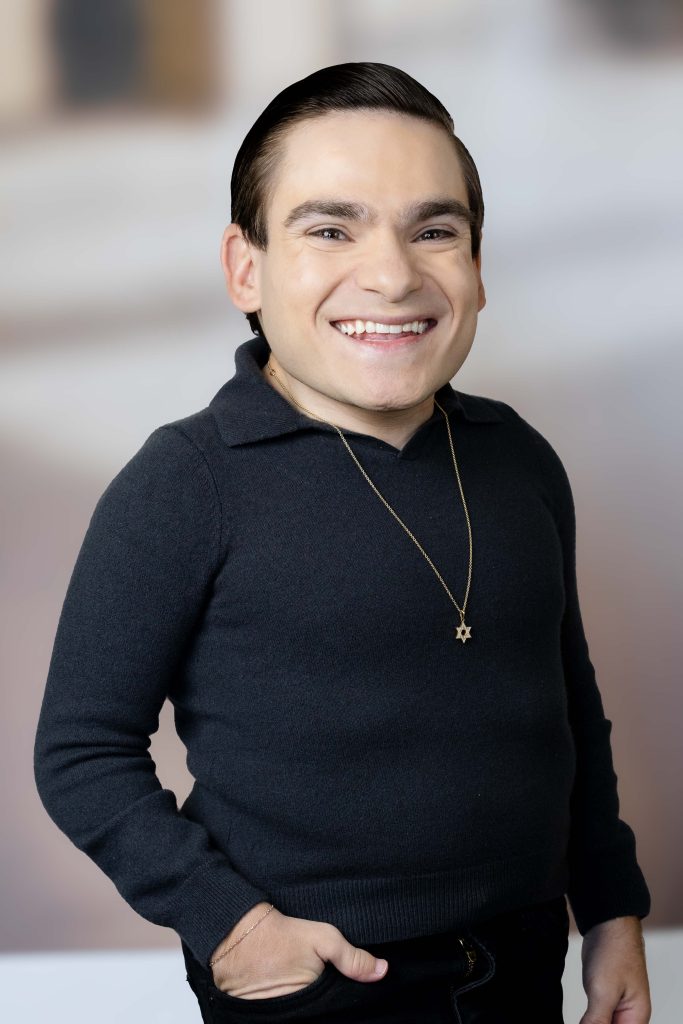
Brandon Farbstein is a renowned speaker, Gen Z activist, and author born with a rare form of dwarfism, has turned his experiences of suffering and isolation into empowerment and influence, inspiring millions worldwide to live life on their own terms.
By clicking “Accept All Cookies”, you agree to the storing of cookies on your device to enhance site navigation, analyze site usage, and assist in our marketing efforts.